TM© THE E-DITOR'S NOTE

SPOTLIGHT
This is our latest article curated for our community of readers. To find and/or revisit any of our past Spotlight topics, visit our Archive.
TECHNOLOGY
AI In Engine Optimization:
GEO, SEO & Vice Versa
By Eleni Stamoulakatou
Originally published on September 2, 2025
Revised: N/A
What Is GEO And Why It Matters
Generative AI search is reshaping how people find information, make decisions and interact with brands. In an effort to offer a seamless and personalized experience, AI-powered tools can provide online users with a tailored, contextually enhanced response for the majority of their inquiries.
GEO (Generative Engine Optimization) improves content for AI models to use when answering queries. It can include brand or content in AI answers, ensure AI finds accurate and trustworthy information from content and align with how AI learns and retrieves information. AI assistants are replacing search engines. Instead of shifting through various Google results (this if content isn't optimized), users may prefer to ask a generative model so a brand could end up vanishing from this new discovery channel.
Generative engines like ChatGPT and AI Overviews (Google) are replacing traditional search engines for information retrieval. Woth that in mind, if content isn’t optimized for these AI tools, then there is a risk being overlooked by future users and consumers thus jeopardize brand or service visibility for companies and publishers.
Users are increasingly rely on AI tools to help them collect information and make well informed decisions, making the growth of GEO move in a fast and steady pace. Companies and businesses are starting to view GEO as a strategic facet of content marketing that helps ensure brand is findable and impactful.
Breaking Down The GEO Mechanics
-
Citations, Sources and High-Authority Signals - Engines surface content from trustworthy and frequently cited sources. That said, if content is well-structured then there is a higher probability that it will be linked in the AI-generated output so the use of backlinks, domain authority, and credibility are considered crucial.
-
Structured, Machine-Readable Content - The use of schema markup, structured data, FAQs, tables, and bullet points is recommended to ensure that LLMs can inspect and analyze information easily.
-
Conversational Content - Generative engines answer using natural language thus content should mimic Q&A-style writing.
-
Semantics - GEO covers topics comprehensively so the use of related terms, synonyms and context is crucial to ensure that AI is able to consider content authoritative.
GEO And SEO - To Each Their Own Yet With All In Between
Traditional SEO is still essential for digital strategy, while GEO offers a modern approach for brand visibility in generative AI searches. That said, for those wondering which is better, the answer is both since GEO is not meant to replace SEO. GEO is a method that works together with SEO and its goal is to improve content so that it performs well in AI-driven search results, focusing on trustworthiness and references that come from AI. Brand assets can solidify topic authority, enjoying the benefits of both organic and generative search to deliver relevant content to online users.
GEO focuses on making sure that the information provided is accurate and reliable, while SEO concentrates more on things like choosing the right keywords, getting links from other websites, and ensuring that the technical aspects of a site are set up well for searchability. SEO optimizes content for keyword ranking in search results and makes content understandable for AI search assistants and chatbots so that they can generate answers. GEO focuses on getting content referenced and cited in the new AI-generated answers provided by tools like ChatGPT and Gemini (Google), rather than just have it rank 1 on Google.
When it comes to how impact is measured, it will be different between the two methods. SEO is an established and mature approach that allows key metrics such as revenue, traffic and search engine results page controllability to be measured. On the other hand, GEO is still evolving thus it will take some time before tools and platforms can reach the same level of granularity that is currently the case with SEO.

Image Credit: Author
Benefits Of GEO
Instead of simple optimization for traditional search engines (i.e., SEO), GEO takes into consideration a threefold: a) how generative AI systems read, b) interpret, and c) synthesize content. Below are GEO's key benefits:
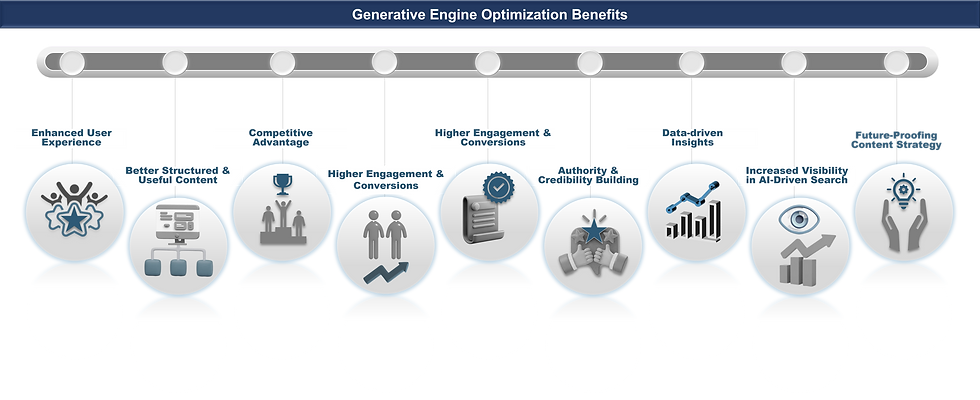
Image Credit: Author
GEO In Digital Strategy
As an integral component of a digital marketing strategy, GEO involves formatting content to make it more possible to be referenced and/or summarized accurately by AI-powered systems. This process includes optimizing content structure, language clarity, factual accuracy and context relevance to help align with how these models process and prioritize data. Traditional digital strategy relies primarily on: SEO (ranking on Google), Paid Ads (search/social/display) and Content Marketing (blogs, videos), however, generative AI engines define what online users and consumers will see first. That said, GEO needs to be treated as a new pillar of digital strategy to help with brand visibility in AI answers and not just search results.
-
Key GEO Objectives in Strategy
-
Visibility - Ensure brand/content is surfaced in AI answers
-
Authority - Position content as a “trusted” source so AI models are more likely to cite it
-
Engagement - Optimize content so AI not only references it but also encourages users to click through
-
Conversion - Align GEO outputs with lead generation, product awareness, or sales pipelines
-
-
GEO Tactics In Strategy And Integration With Other Digital Tactics
-
Content Marketing - Q&A formats to help mirror AI prompts, clear definitions, comparisons, and structured data, comprehensive coverage of user intent (full context vs keywords only)
-
SEO And GEO Hybrid - SEO will continue yet AI-friendly formatting will need to be added (ie.g., FAQs, schema.org markup, bullet-point summaries, citations & sources)
-
Paid Media - Paid ads may shift as AI engines absorb search while GEO can reduce reliance on paid ads by increasing organic inclusion in AI-generated responses
-
Branding & Trust - AI models prioritize authoritative sources, building digital PR, thought leadership, and backlinks enhances both SEO performance and GEO authority
-
Technical Infrastructure - Sites need to be crawlable by AI scrapers (avoid paywalls, excessive gating), and wll also need to use APIs, structured databases, and clean HTML to integrate with retrieval-augmented AI systems
-
-
Strategic Framework for GEO - GEO can and should be integrated into digital strategy as follows:
-
Discovery – To help identify where AI engines already pull info in an industry
-
Audit – To analyze what content is AI-friendly vs invisible
-
Optimization – To reformat content to align with GEO best practices
-
Distribution – To help enable publishing across channels AI engines crawl
-
Measurement – To help track mentions, citations, traffic from AI engines
-
Iteration – To refine based on what works
-
In Emanuel Rose’s, “Generative Engine Optimization (GEO): Beyond SEO in the Age of AI”, one of the core focus and key themes is that of strategic guidance. In his study, Rose offers actionable advice tailored for digital marketers, content creators, and businesses, covering how to harness AI engines, speaking both to AI models and human audiences, and ways to integrate relevant tools and methods into digital strategies. This comes through a practical format that includes: case studies, step-by-step instructions, and hands-on tips to thrive in the AI-first digital marketing landscape.
Some additional themes het touches upon, include:
-
Why GEO Matters: Traditional SEO isn’t enough in a world where AI-driven engines increasingly surface information directly to users. The book emphasizes the importance of being discoverable by AI systems.
-
Shifting the Paradigm: It helps marketers transition from keyword-centric content to “content-driven GEO,” where producing structured, AI-friendly content defines visibility.

Image Credit: Author
SEO Stays And Generative AI Joins The Race Toward Engine Optimization
Traditional SEO won't be going anywhere, while at the same time GEO will continue to evolve content visibility, credibility, and utility. By aligning with generative systems’ methods of interpreting, summarizing, and recommending information, GEO can help brands remain discoverable, establish authority, and engage audiences in the new search era. In an AI-driven world, early adopters will gain visibility but also influence trust in the digital landscape of the future.
References/Useful Links
-
Generative AI for SEO: Be the #1 Answer in AI Search, Coursera
-
Introduction to Generative Engine Optimization (GEO), The Open University
-
SEO Training Masterclass 2025: Beginner to Advanced SEO, Udemy
-
Introduction to Google SEO, Coursera
-
Google Ads vs. SEO: A Guide, Built-in
-
Generative Engine Optimization (GEO): Beyond SEO in the Age of AI, Amazon